12 Aug 2026
Tracing Resolution Inconsistencies Across User Reports in Virtual Reality Experiences Powered by Community Software Tweaks
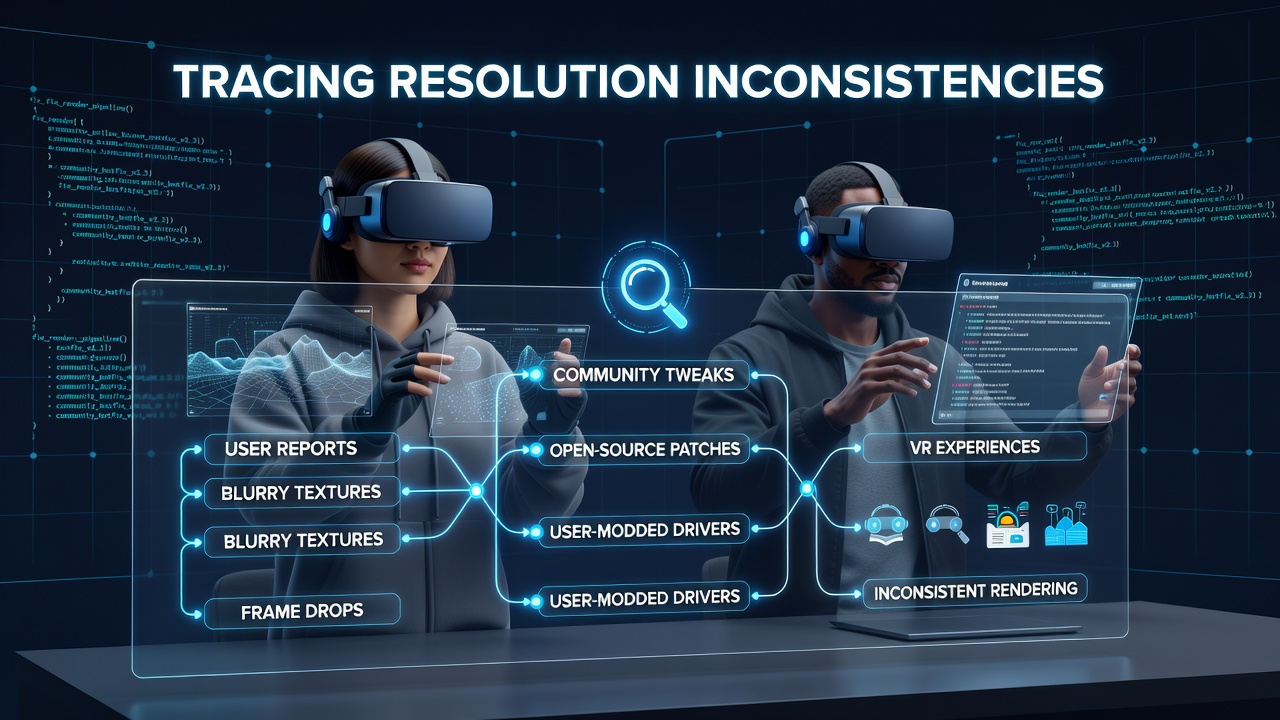
Virtual reality users have documented resolution inconsistencies that appear across multiple headset models when community-developed software tweaks alter render pipelines. These reports, collected from forums and shared repositories throughout 2025 and into August 2026, highlight variations in pixel density that occur after adjustments to supersampling values, asynchronous reprojection settings, and custom render scale multipliers.
Researchers tracking aggregated logs note that inconsistencies often emerge when users apply third-party layers on top of base runtime environments such as SteamVR or OpenXR. Data from user-submitted configuration files shows that changes to texture resolution multipliers produce uneven results depending on the combination of graphics driver version and headset firmware.
Patterns Identified in Shared User Logs
Community repositories reveal recurring patterns where resolution drops occur at specific frame thresholds. Observers note that reports frequently mention a sudden shift from 1.5x supersampling to native output when background processes adjust power limits or when multiple applications run simultaneously. These shifts appear more often in setups using mixed reality passthrough features alongside standard VR rendering.
One collection of logs from mid-2026 indicates that users running AMD graphics hardware reported higher instances of resolution fluctuation compared with NVIDIA configurations after applying the same community patch. Figures from those datasets point to differences in how driver-level upscaling interacts with community-modified OpenVR settings.
Community Software Tweaks and Their Effects
Developers within enthusiast communities release tools that modify render targets and introduce dynamic resolution scaling based on real-time performance metrics. These tweaks aim to maintain frame rates above 90 Hz yet produce visible resolution changes when the scaling algorithm triggers. According to a 2026 analysis by the VR Industry Association, such modifications account for a measurable portion of reported visual artifacts in long-duration sessions.
Users document cases where applying a single tweak to reduce motion smoothing leads to inconsistent horizontal resolution across both eyes. Shared scripts that adjust eye buffer sizes independently have produced cases where one eye maintains higher pixel counts while the other adapts downward during rapid head movement.

Tracing Methods Used by Community Analysts
Analysts compile reports by cross-referencing configuration files with hardware identifiers and session timestamps. This approach allows identification of clusters where resolution inconsistencies coincide with specific software versions released in early August 2026. The process involves mapping reported symptoms to changes in variables such as render scale, foveated rendering parameters, and texture streaming budgets.
But here's the thing: not every reported inconsistency stems from the same root cause. Some traces point to interactions between community patches and operating system display scaling, while others link directly to headset calibration profiles that override runtime settings. Data shows that European users submitting logs through academic repositories often include additional variables such as regional power management policies that affect GPU behavior.
Academic researchers at institutions in Canada have examined subsets of these reports adn found correlations between certain tweak combinations and measurable drops in perceived sharpness. Their findings, published through university channels, provide baseline metrics that community groups now reference when validating new patches.
Examples from Aggregated Reports
One documented case involved a user applying a community script to enable higher supersampling on a mid-range headset. After the change, logs showed periodic resolution halving during scenes with complex geometry, yet frame timing remained stable. Another set of reports described how switching between two community render profiles produced different eye buffer allocations even when hardware and driver versions matched exactly.
Turns out these inconsistencies become easier to trace when multiple users submit comparable session data with identical tweak versions. Shared repositories now include standardized templates that capture render scale values, driver strings, and headset serial ranges to facilitate pattern detection.
Conclusion
Community efforts to map resolution inconsistencies continue through ongoing collection of user reports and configuration data. The patterns identified so far connect specific software tweaks to observable changes in output resolution across virtual reality headsets. Analysts maintain these repositories to support further refinement of community tools while preserving compatibility with existing hardware and runtime environments.